
This blog post has been written by Dr Sameera Chauhan, Associate Lecturer in History at the Australian National University.
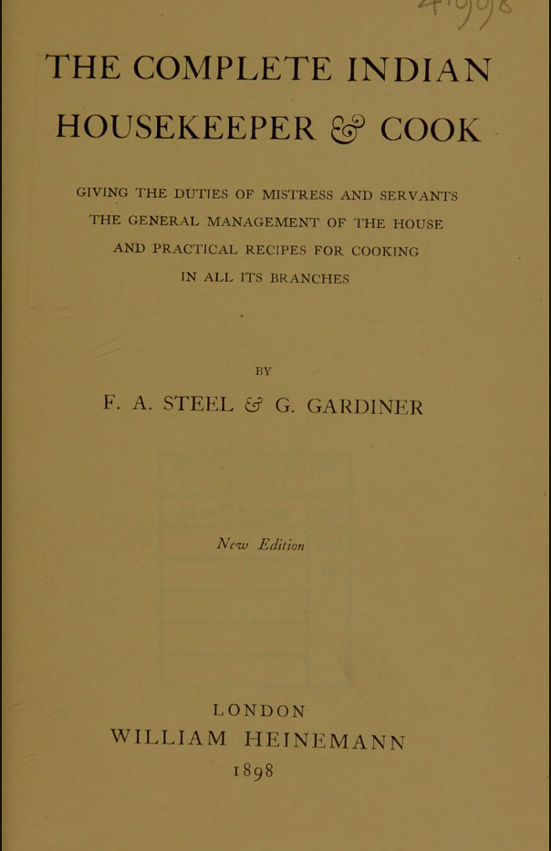
In 1888, two Englishwomen compiled a guide to good housekeeping in India and produced one of the sharpest documents on how empire actually worked in the quotidian. Flora Annie Steel and Grace Gardiner’s The Complete Indian Housekeeper and Cook advised young memsahibs on how to store their rice, season their soup, and stock their medicine chest. It also told them, in the same brisk, business-like prose, how to manage their Indian servants: “the Indian servant is a child in everything save age and should be treated as a child”.[1] “The laws of the household should be those of the Medes and Persians, and first faults should never go unpunished. By overlooking a first offence, we lose the only opportunity we have of preventing it becoming a habit. But it will be asked, how are we to punish our servants when we have no hold either on their minds or bodies? when cutting their pay is illegal, and few, if any, have any real sense of shame. The answer is obvious. Make a hold”. When servants proved forgetful or slow, the authors recommended castor oil “on the ground that there must be some physical cause for inability to learn or to remember”. While hardly the material of jest, one can catch a glimpse here of a racialised medical logic which characterised native constitutions as inherently infirm and indolent and, in this case, worked to make that body available for the mistress’s intervention.
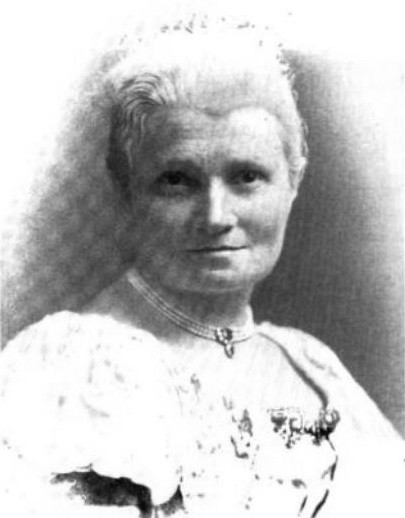
Flora Annie Steel had a penchant for portraying life in British India in vivid colours. She spent 22 years in the Punjab as the wife of an Indian Civil Service officer, and her housekeeping manual went through more than ten editions by 1917. Read today, it is less a cookbook than a training manual for empire, teaching British women to govern a household the way their husbands governed a province. This voluminous ‘how to’ guide for European wives in colonial India offers advice on a range of things, including recipes for hot puddings and cold sweets, remedies for the preservation of health in India’s ‘hostile’ tropical climate, throwing parties and management of servants, accounts keeping, and on the management of young children.
A prolific writer, she garnered considerable fame for her writings, which included her prominent Indian Mutiny novel, On the Face of the Waters (1897) as well as a collection of folk tales, Tales of the Punjab (1894).
It would be easy to read The Complete Indian Housekeeper and Cook as a curiosity: a period piece, full of recipes for mulligatawny and instructions for treating bites from “mad, or even doubtful dogs”. Steel and Gardiner were witty, well-travelled, and often very funny. But the book rewards closer attention, because Steel and Gardiner themselves tell us what they think they are doing: “An Indian household can no more be governed peacefully, without dignity and prestige, than an Indian Empire”.
Steel and Gardiner make the analogy explicitly, and it is operationalised in practical advice on rules, hierarchy, and punishment. The mistress of an Anglo-Indian household needed the same tools of authority as the colonial state: firm rules, visible hierarchy, and swift, unembarrassed punishment. The domestic sphere and the political one were not separate rooms in the same house. In this manual, they are deeply intertwined.
Governing the household body
The manual devotes an extraordinary amount of space, some 46 pages in later editions, to the minute regulation of servants: what they should be paid, how they should be dressed, where they should sleep and, above all, how they should be supervised and disciplined. The authors’ advice on discipline reads like a small treatise on colonial governance. Faced with the “burning question” of how to punish servants who could not legally be docked pay, the authors’ answer is blunt: “Make a hold.” What follows is a system of fines and rewards designed to give the mistress leverage over servants’ bodies as much as their labour, culminating in the castor-oil punitive, in which physical purgation stands in for correction, punishment masquerades as medicine.
This was hardly incidental. Ideas about tropical climate, hygiene, and disease were commonly deployed to police the boundary between British and Indian bodies in this period. Climate itself functions as a kind of racial technology, sorting who could tolerate India and who could govern it. Steel and Gardiner’s manual sits squarely inside that world. Her opening chapter contrasts the mistress who “enforces cleanliness according to European methods” with the one who tolerates a kitchen “also used as a latrine,” and warns that a dirty copper saucepan is “no more fruitful source of danger and disease” than an untrained servant left unsupervised. Hygiene here is not neutral housekeeping advice; it is a daily, domestic performance of the same civilisational hierarchy that underpinned colonial medicine, sanitary law, and public health policies across British India.
None of this makes Steel unusual for her time, which is rather the point. What makes The Complete Indian Housekeeper and Cook valuable to historians is exactly its ordinariness: it was not a political tract but a wedding present, a practical manual that sold in the thousands to women who had no interest in governance and every interest in getting dinner served on time. That is how empire is actually reproduced, not chiefly through viceroys and dispatches, but through the unremarkable choreography of daily domestic life, repeated in household after household across the British world.
Australian readers might recognise this genre in Mina Rawson’s manual Mrs Lance Rawson’s Cookery Book and Household Hints (1878). Settler Australia had its own literature of domestic management, its own anxieties about servants, climate, and “acclimatisation,” and its own arguments about which bodies could safely labour in which conditions. Beyond culinary and domestic practices such texts codified wider cultural and social practices. Steel’s memsahibs and Australia’s colonial housewives were reading, in effect, chapters of the same wider British-world manual on how to run an empire from the pantry outward.
That is worth remembering the next time a Victorian housekeeping guide turns up in a second-hand bookshop, its recipes for quenelles and custard sitting only a page away from instructions on how to discipline the person whose labours made them. The comedy and the coercion were never truly separate. Steel and Gardiner knew that and it’s why they wrote both into the same sentence.
[1] The Complete Indian Housekeeper & Cook: Giving the Duties of Mistress and Servants, the General Management of the House and Practical Recipes for Cooking in all its Branches. London: William Heinemann, 1902 edition. Reprint of 1898 original. https://wellcomecollection.org/works/hj9b6a53/items?canvas=170, p.2.

Readers may be interested in the IHR’s seminar series on Britain at Home and Abroad, Migration and Mobility History, and Food History.