
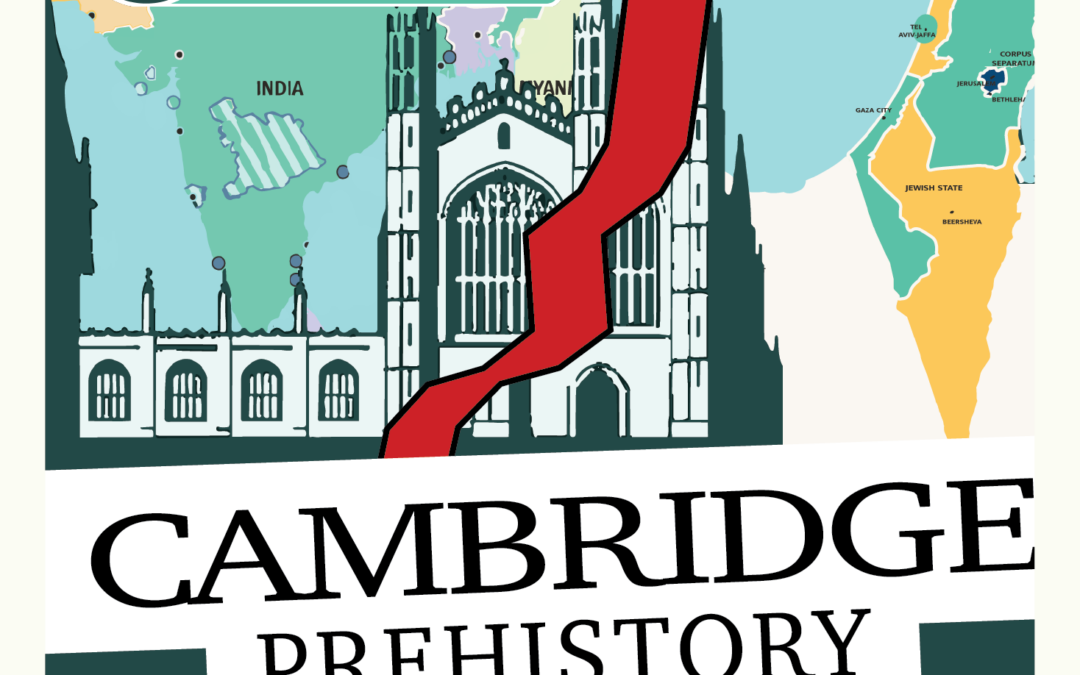
Cambridge is a city of quiet quadrangles and soft light, designed for the unhurried pursuit of knowledge, polite debates over High Table, the preservation of tradition, and the education of the country’s youthful elites.
Yet between the cobblestones of Trinity Street and the vaulted ceilings of Senate House lies another Cambridge: one shaped by radical ideas, political activism and turbulent encounters with the wider world. In the first half of the twentieth century, the city was not simply a detached observer of international affairs. It was one of the places where the political and intellectual currents that would reshape the twentieth-century world were debated, developed and connected.
As a global historian, I am particularly interested in these unexpected connections between the spaces of everyday life and the historical forces that have shaped them. They remind us that our lives and landscapes are rarely the product of events contained within the boundaries of a single city, country or continent. At Uncomfortable Cambridge, a community interest company that uses discussion-based walking tours to explore difficult histories and their legacies in the present, we have made this relationship between the local and the global central to our work.
One particularly unexpected connection can be found in Cambridge’s relationship to the prehistories of Partition in South Asia and the Middle East.
What does Cambridge have to do with the partitions of India and Palestine?
At first glance, the answer might seem surprising. The partitions of India and Palestine took place thousands of miles from Britain. Yet Cambridge was connected to the people, ideas and political projects that helped shape both.
From the political circles surrounding Mohandas K. Gandhi and Muhammad Iqbal to debates over the Balfour Declaration and the future of the British Mandate in Palestine, members of the University were deeply entangled in the struggles over empire, nationalism and self-determination.
For the Cambridge Festival in 2025, Uncomfortable Cambridge collaborated with historian Dr Erin O’Halloran to explore these connections through an embodied learning activity: the Cambridge Prehistories of Partition walking tour. Moving through the city, tour participants encountered buildings and spaces associated with individuals whose lives and ideas connected Cambridge to the radical political transformations taking place across South Asia and the Middle East.
The tour has now been adapted into a podcast, launching on 18 September 2026.
From Cambridge to the end of empire
Partition is often remembered through the dramatic events of 1947 and 1948: the independence of India and Pakistan, the end of the British Raj, the establishment of Israel on Palestinian lands, and the displacement, conflict and violence that accompanied these transformations. But partition did not emerge suddenly.
The drawing of new borders was the outcome of much longer histories of imperial rule, anticolonial politics, competing nationalisms and arguments over who had the right to determine the future of particular territories.
O’Halloran’s research brings these histories into conversation. Her book, East of Empire: Egypt, India and the World between the Wars (Stanford University Press, 2025), follows the interconnected histories of Britain, Egypt, India and Europe from the Treaty of Versailles in 1919 to the votes in favour of partition in India and Palestine in 1947.
The Cambridge walking tour offered a way of making these global connections tangible and to focus on place-based learning. Streets, colleges and university spaces became points of departure for stories about activists, diplomats, poets, politicians and spies whose lives crossed the boundaries of empire. Alongside figures such as Gandhi, Iqbal, Antonius and Balfour, the tour revealed the less familiar networks through which political ideas travelled and changed.
In this form of embodied storytelling, Cambridge is not simply the backdrop to these histories. It is one of the places where they were debated, developed and brought together.
Why ‘prehistories’?
The word ‘prehistory’ in the project’s title is deliberate. It shifts our attention away from Partition as a single moment of rupture and towards the political and intellectual histories that made partition imaginable.
This approach also challenges the tendency to study the histories of India, Palestine and Britain separately, divided by national boundaries and disciplinary specialisms. The tour instead traces the connections between them, showing how people living and working within the British imperial world encountered one another, exchanged ideas and responded to shared political challenges.
The history of Pakistan provides one striking example. Pakistan did not simply appear as a political idea in 1947. Its emergence followed a much longer debate about political representation, Muslim identity, territory and the future of British India. Cambridge was one of the places in which those debates took shape.
Palestine offers another. The consequences of the Balfour Declaration and the British Mandate cannot be understood in isolation from the wider international and imperial debates of the period. For contemporaries, developments in Palestine and British India were not necessarily separate stories. They were part of a common world of imperial administration, anticolonial mobilisation and competing visions of self-determination.
Following these connections allows us to see the end of empire differently: not as a series of isolated national stories, but as an interconnected process in which political possibilities were imagined, contested and sometimes transformed into new territorial realities.
Cambridge as an archive
The collaboration between O’Halloran and Uncomfortable Cambridge was facilitated by the Researching Legacies of the Past Project at the Centre for Heritage Research at the University of Cambridge.
The project raises a question at the heart of public history: how can research change the way we understand the places around us and not only acknowledge historical injustices but also foster dialogue and reflection as potential forms of redress?
A walking tour offers one answer. Rather than encountering history only through books and archives, participants move together through the city itself and openly discuss some of these legacies, connecting buildings and streets with people, ideas and events that unfolded across continents. The familiar urban landscape becomes an archive.
This is also why walking can be such a powerful form of historical learning. Movement creates connections between places that might otherwise seem unrelated, while the physical environment provides a tangible starting point for exploring much larger histories. A Cambridge street can become a route into the history of British India; a university building can open onto debates about Palestine; a biography can reveal the networks connecting intellectual life in Britain with anticolonial movements across the empire.
From walking tour to podcast
The podcast extends this approach beyond Cambridge.
Hosted by Waqas Mirza, Education and Learning director at Uncomfortable Cambridge, and featuring O’Halloran, the series retraces the route of the original walking tour and adapts its stories for listeners who might be able to follow the steps of the tour in their own time. Together, they retrace the spaces and individuals whose intellectual contributions and political activism continue to resonate in contemporary geopolitics.
The Cambridge Prehistory of Partition Podcast was launched on 18 September 2026 and new episodes will be published fortnightly until December: https://www.uncomfortablecambridge.com/podcast
The podcast offers another way into this history beyond the walking tour. Whether you listen at home or decide to walk the route, it offers an opportunity to reconsider a familiar city—to reconnect it with the world that it shaped.
The podcast series was produced by Olivia Durand and Paula Larsson, co-founders of Uncomfortable Tours. We are grateful to the Institute of Historical Research for making its recording studio available for the production of the series.