
This blog post was written by IHR Associate Fellow Michael Carter.
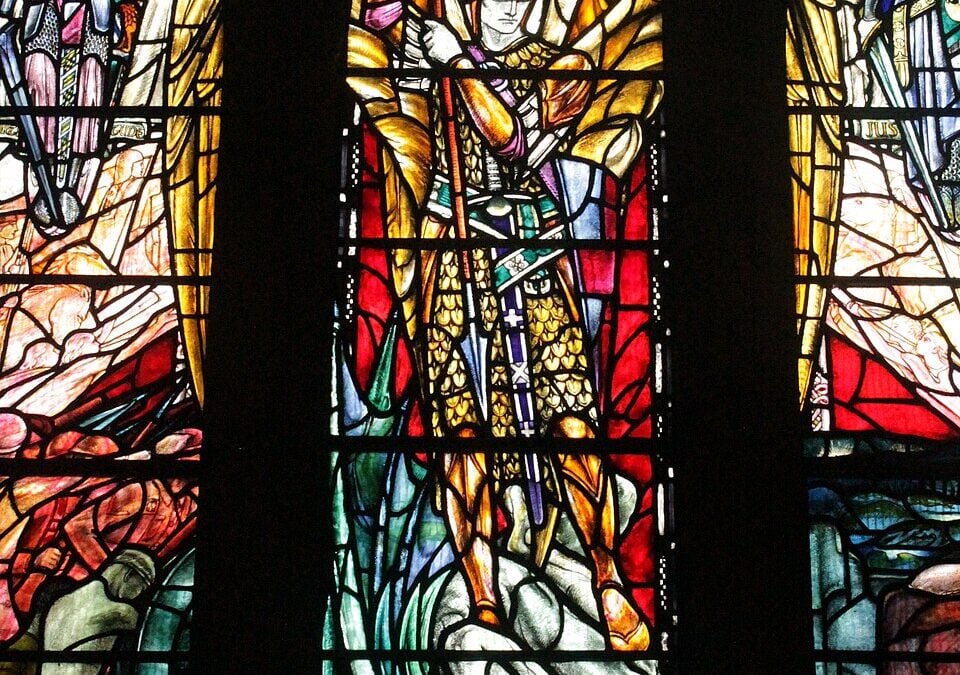
St Michael’s Day—Michaelmas—on 29 September is upon us. St Michael is one of the most interesting of all saints, or to go medieval ‘the holy company of heaven’ (ok, I might be biased, I’m named after him and I also went to a school dedicated in his honour). But even leaving aside my prejudices, St Michael the Archangel was—and still is—arguably the most famous of all God’s angels. He’s been venerated as the commander of the angelic armies, a holy healer, a protector of high places and as a companion during our final journey between this world and the next. With so many talents, it’s easy to understand why St Michael was among medieval Europe’s most popular and widely depicted saints—and also why there are solid reasons why he should still excite our interest and command our respect in our increasingly secular and fractious age.
There are sound Scriptural foundations to St Michael’s veneration. The saint is mentioned in the Book of Daniel as one of the chief princes of the heavenly host and as special protector of Israel. In Revelation, he is God’s triumphant champion in the celestial battle between the forces of good and evil.
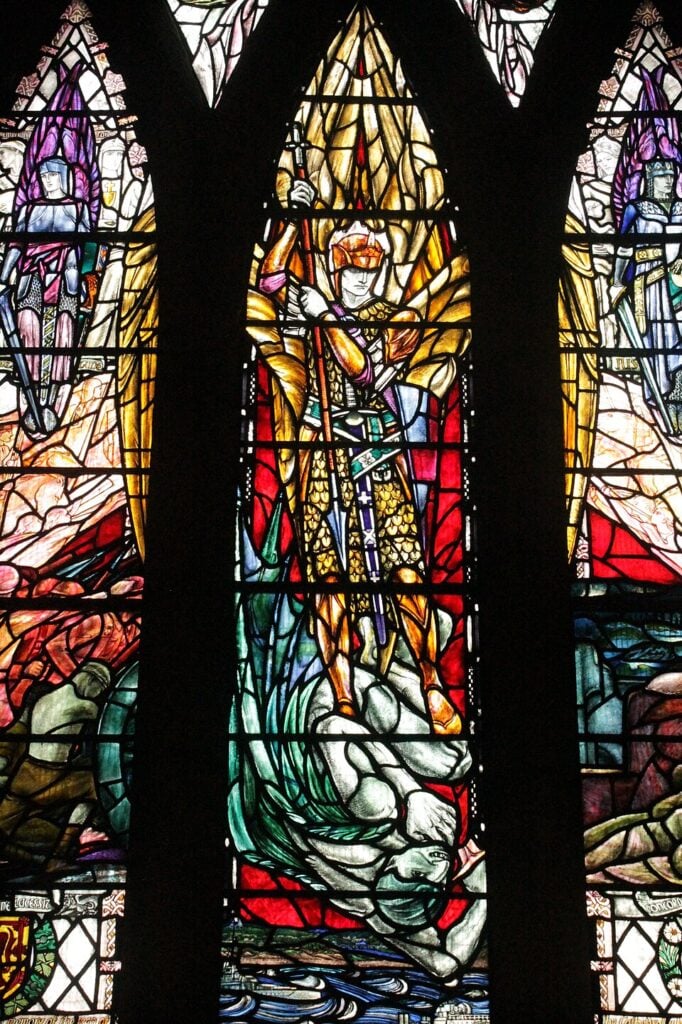
St Michael was also a favourite in Biblical Apocrypha. Descriptions of him in numerous apocryphal texts, such as the Testament of Abraham and the Life of Adam and Eve, led to him acquiring a special association with water. St Michael’s nascent Christian cult in what’s now Greece and Turkey was focused on fountains and springs, especially those credited with healing powers. The archangel was said to have sanctified several of these watery places with an appearance and Constantine the Great ordered a shrine to be built—the Michaelion—in one such location.
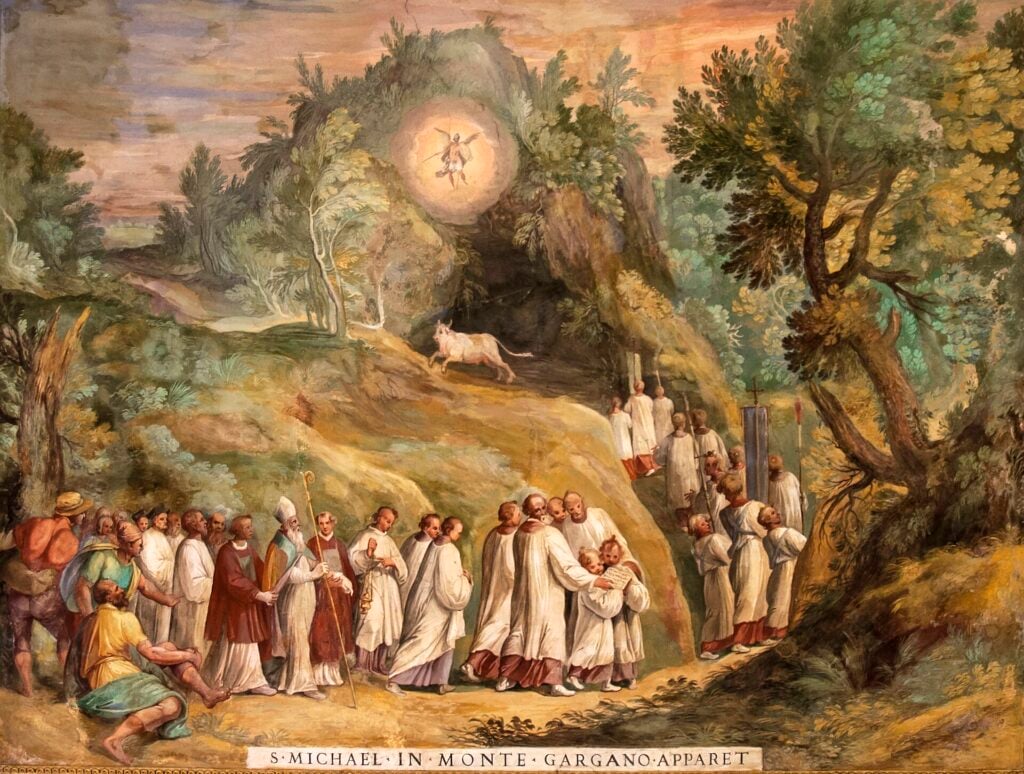
Veneration of St Michael in Western Europe was turbocharged by a series of visions of the archangel. Three are said to have occurred at Mount Gargano in southeast Italy during the 5th century, the holy mountain becoming a centre of his cult in the following centuries. Another apparition occurred in 6th-century Rome. During an outbreak of the plague, Pope Gregory the Great was said to have witnessed the angel standing atop the tomb of the Emperor Hadrian. The pontiff described the angel sheathing his bloody sword, a sure sign of St Michael’s intervention to save the city from the pestilence. The location of the apparition was named Castel Sant’Angelo, later repurposed as a papal fortress—likely coincidental but unquestionably appropriate, given the archangel’s military associations.
The archangel was also believed to have graced northern Europe with visits, the most famous in 709 when he was said to have appeared on the summit of a mountainous outcrop off the Normandy coast called forever after Mont Saint-Michel. A similar vision (though only described in a late medieval source) was the reason for the naming of St Michael’s Mount off the Cornish coast. Both these holy hills became the location of monasteries.
You’ll have noticed a common theme here, with St Michael prone to making himself manifest in lofty locations. This association between the archangel and high places endured throughout the Middle Ages: the church atop Glastonbury Tor was dedicated to the saint, so too a chapel on a hillock to the south of Fountains Abbey. People in the Middle Ages would have readily understood the reason. As explained in the Golden Legend, a collection of saints’ lives composed in 13th-century Italy, Lucifer and his fellow fallen angels inhabited the air “between heaven and earth” and “fly around us like flies.” Luckily, the ever-vigilant St Michael, resplendent with wings composed of rainbow coloured feathers, was there to swat these foul fiends with his drawn sword. His sculpted image was placed on many a tower to deter the buzzing forces of evil and reassure the faithful of his protective presence.
St Michael’s sacred services were also available for the dying. The archangel stood ready to do battle with Satan for the souls of the recently departed. ‘Then shall ye all knel adowne, and pray to Seynt Michaell, that he apere to you, and when ye shall passe out of this world, and defend you from your emmyse, and bring you to the joye of paradise’, wrote John Mirk, a canon and later prior of Lilleshall Abbey, in the years around 1400.
Because of these deathbed services, St Michael came to be regarded as a “psychopomp,” a trusty guide for souls on their journey from Earth to the afterlife. And once a soul had reached the Pearly Gates, it was weighed in scales held by the archangel to determine if its virtue was sufficient to warrant passage to everlasting bliss. Given his role as a sort of holy bouncer, it doesn’t take too much imagination to work out why cemeteries and funerary chapels across Europe were dedicated to St Michael.
Pilgrims flocked to the saint’s shrine at Mount Gargano, many etching their name into the rock close to where St Michael was said to have appeared. Among those making the pious peregrination was a group of Norman knights. Their visit to the holy mountain in the early 11th century was a major catalyst for a chain of events that resulted in the Norman conquest of Sicily.
Stones chipped from the site of Michael’s apparitions at Gargano were disseminated as sacred relics. To stay with the Normans, two found their way to Battle Abbey, William the Conqueror’s great penance for, and memorial to, his victory at the Battle of Hastings in 1066. The angel’s sacred military associations appealed to the warrior elites of medieval Europe. Chivalric orders were founded under his patronage.
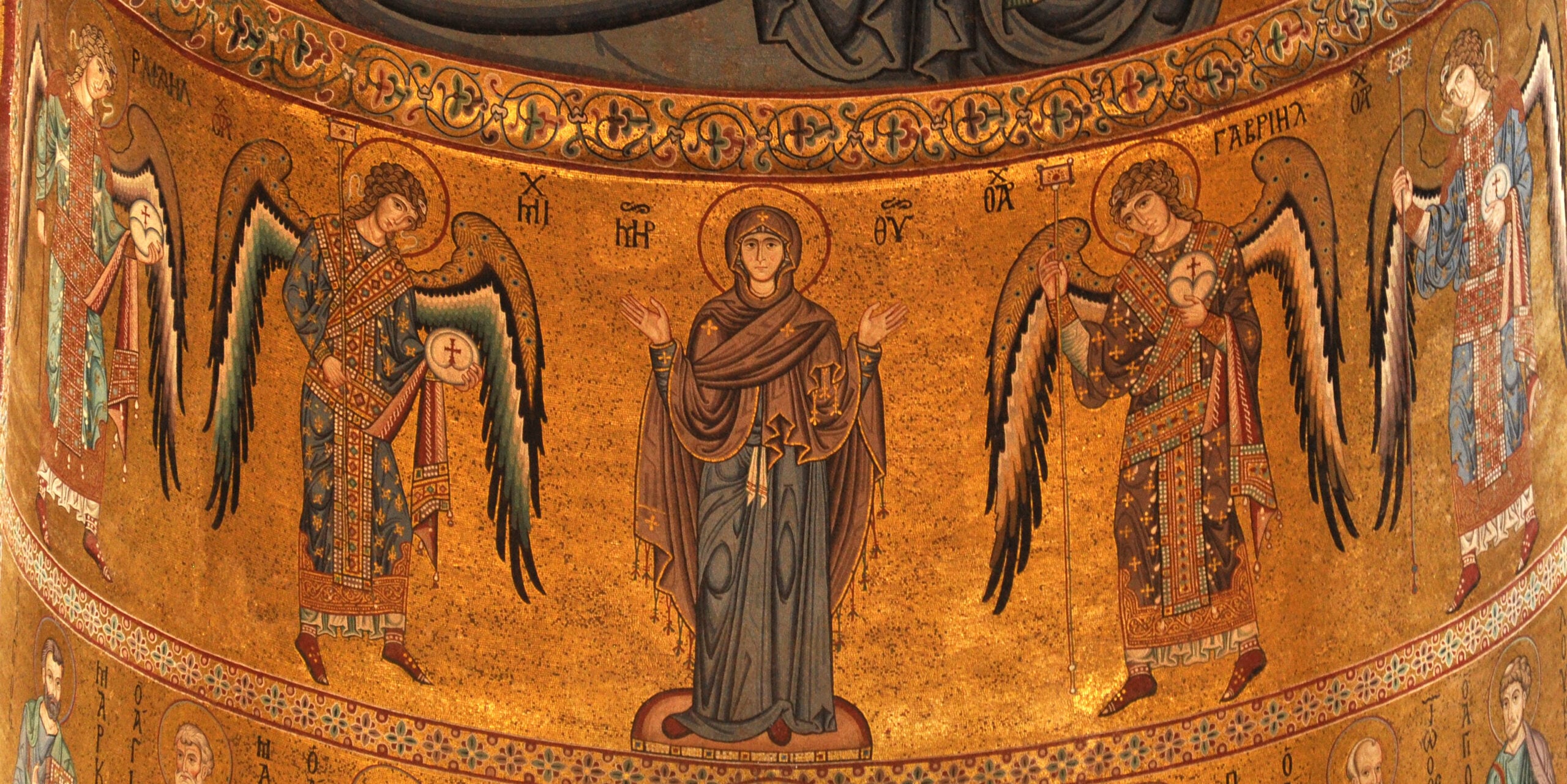
For centuries, artists have found inspiration in St Michael’s multiple roles: peaceful angel in the glorious 12th-century mosaics at Cefalù Cathedral, Sicily; a holy warrior on multiple late medieval East Anglian rood screens; a weigher of souls in Hans Memling’s terrifying 15th-century panel painting of the Last Judgement.
His feast on 29 September commemorates the 5th-century dedication of a basilica in his honour in the outskirts of Rome. The English name for the feast is, of course, Michaelmas. One of the historic “quarter days” when the rent had to be paid, it also gave its name to the academic and legal terms that start at this time of year. It’s not unusual for there to be a spell of fine, warm weather in late September—this year is no exception. We now usually call this an Indian Summer but in bygone ages it was labelled a Michaelmas Summer—surely an appellation worthy of revival in these times of increased sensitivity to the use of language. It might even be something that both sides in the ‘culture war’ can agree upon. That might be St Michael’s greatest miracle of all.
Dr Michael Carter is an Associate Fellow of the IHR, Fellow of the Society of Antiquaries of London, and a council member of the British Archaeological Association. Michael is a prominent British historian and art historian, formerly of English Heritage. He is an expert on medieval monasticism, particularly focusing on the late Middle Ages (c. 1300–1540), monastic art, architecture, and religious relics. His major academic work includes the monograph The Art and Architecture of the Cistercians in Northern England, c. 1300–1540 (published in 2019). He frequently appears on podcasts, media programs, and public lectures to make monastic history engaging and accessible to the public.
Readers may be interested in attending the IHR’s seminars on topics including religious history, medieval history, liturgy, and Italian history. Open to the public and free to attend, some online, some in person, and some hybrid. See the full program here: IHR Seminars | Institute of Historical Research.
Read about Religious History Collections | Institute of Historical Research in the IHR Library.