
Bibliography of British and Irish History (BBIH) Intern in Environmental Histories Zoë Jackson uses two petitions as a starting point to reflect on environmental history as a field, and the usefulness of BBIH to this research.
Petitions and Pathways
In 1658, the inhabitants of a number of towns petitioned the Cheshire Quarter Sessions for funds to create ‘a stone cawsey’ as the only solution to their difficulties in maintaining a particular highway.1 According to the petition, ‘although your peticioners have endeavoured as much as in them lyeth to have the way passable to their great charge and expences’, such attempts were ‘made ineffectuall by reason of severall floodes’.2 Searching through Quarter Session records, it is not unusual to find petitions related to highways. But this petition differs from the more formulaic articulations of disrepair by the additional detail provided about why the road was unusable, and what the petitioners had done and proposed to do about it.
Even more detail is provided in a July 1681 petition by James Wilmott to the Worcestershire Quarter Sessions in regard to the need for work on a local horse-bridge. Before describing the poor state of the horse-bridge, he explained that ‘severall hundred of yeares agoe’ his ancestors had built ‘on the land belongine to the said former Lord Bishopp [of Worcester] and nowe to the present Lord Bishop five fulling milles and a corne mill and did then cutt a trench through the same downe to the roade way leadinge betwixt Worcester and Bewdly and did by the said cutt make the said cutt footeway enpassable for foote persones’ which led them to build only a footbridge. o According to the petition, the horse-bridge was only built approximately sixty years before the time of the petition (intriguingly, as a yeoman’s punishment from the ecclesiastical court for ‘begettinge a bastard childe’).3
What links these two records together, beyond the fact that they are both petitions from the later 17th century about local infrastructure, is that they concern roads in their natural environments, the factors shaping them, and the human interaction both with the roads and the environments more broadly. Both examples suggest changes to the environment, and subsequent changes to the ability to use paths in the area. In Cheshire, it is unclear why exactly the road was flooding, but the consequence of this flooding was that the petitioners required a new road to be built, which might have its own effects on the landscape. In Worcestershire, the changing landscape was a direct and known result of human activity. The need for both the footbridge and the horse-bridge was the result of digging a trench that interrupted the original route, which had been known and experienced by members of this community for centuries.

Memories and descriptions of paths from the early modern period appear in all sorts of records, from petitions related to road and bridge degradation and repair like the ones above, to records from litigation contesting the routes of such paths and the impact of enclosure on them, to more visual records like maps and estate plans. For my own research, I am interested in these kinds of references for what they tell us about how and why people remembered such pathways and the landscapes in which they were situated, everyday engagement with the law (through the medium of petitioning) in relation to local environments, as well as what such sources reveal about early modern understandings of environments more broadly.
Environmental Histories and BBIH
Environmental history is a vast and growing field (or, perhaps, ‘an interdisciplinary meeting place’, as suggested in a recent roundtable and its accompanying blogpost).4 The interdisciplinarity integral to the field encourages reflection on how different disciplinary approaches can best be brought together to illuminate questions about past environments and human interactions with them. Environmental histories are also often positioned in relation to modern environmental concerns and the potential impact of such research on environmental policy and issues today. This is as true of early modern environmental history as it is of modern environmental histories, even as it might be more straightforward for the latter.5
As the BBIH Intern, one of my projects focused on reviewing and updating the subject terms related to environmental history. With such an interdisciplinary field, and with such a vast range of subjects that could fall under it, this project forced me to think deeply about the scope, and limits, of environmental history, and how best BBIH could serve those conducting research in it. This project also forced me to think about where environmental history comes into my own research, and where it intersects with other fields, such as landscape history.6
BBIH offers an extremely useful resource for all the many potential directions of research. In the development of research projects in environmental history, BBIH provides a useful starting point for finding relevant scholarship, perhaps in relation to across new sources that offer fresh perspectives on your research questions. Searching for the subject ‘petitions’ in the years 1600–1750 produces 135 results, while searching for the same subject along with the term ‘environment’ gives me five results. Searching for the subjects ‘mills’ and ‘roads’ provides 13 results, while adding the subject ‘environment’ limits this to nine hits. Searching for the subject term ‘floods’ produces 186 results, while limiting that search to the period 1600–1750 would give me 64 results.
It is also a uniquely valuable resource for finding scholarship across fields and disciplines (though limited to those with some historical dimension and connected with British and Irish histories). For my research, which brings together landscape and environmental histories with legal history, social history, and memory studies, BBIH offers a unique resource for thinking across these fields and finding scholarship that does the same. BBIH has encouraged me to be creative in how I think between and amongst these fields, experimenting with bringing together subjects from ‘Environment’, particularly in relation to land use, with subjects like ‘Memory’ or the range of subjects under ‘Order, disorder, and legal history’, or exploring specific types of sources, like maps, and the histories for which they have been used. While BBIH has been an important tool for me throughout my postgraduate studies and in my research since, contributing to and reflecting on how the Bibliography is actually organised has stimulated new ways of thinking about my research, and new ways I can put the resource to best use.
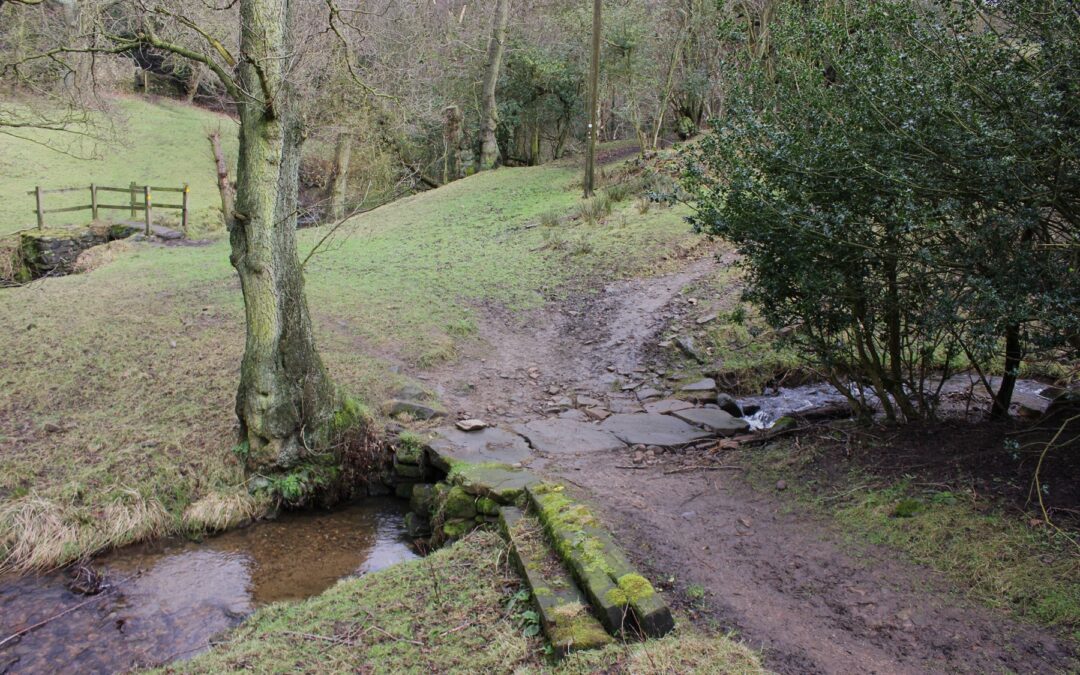
Image caption and credit: A small stone bridge across a stream in Cheshire. Photo © Peter Turner (cc-by-sa/2.0)
Dr Zoë Jackson is a historian of early modern Britain with particular research interests in social histories and the law, memory, and the landscape. Her doctoral research explored the relationship between perjury, or lying under oath, and memory in the law courts of later 17th-century England, and her current research focuses on memories of rights of way in early modern England and Scotland.
FOOTNOTES
[1] The Oxford English Dictionary indicates that ‘cawsey’ is an alternative term for ‘causeway’. Oxford English Dictionary, ‘causey (n.)’, June 2026, https://doi.org/10.1093/OED/1093711669.
[2] The inhabitants of Stanthorne, Occleston, Newton, Hutton and adjacent towns, QJF 86/1/125 (1658),
‘Cheshire Quarter Sessions: 1658’, in Petitions to the Cheshire Quarter Sessions, 1573-1798, ed. Sharon Howard, British History Online, accessed 18 August 2026, https://www.british-history.ac.uk/petitions/cheshire/1658.
[3] James Wilmott of Hartlebury, Ref.110 BA1/1/139/58 (1681), ‘Worcestershire Quarter Sessions: 1680s’, in Petitions to the Worcestershire Quarter Sessions, 1592-1797, ed. Brodie Waddell, British History Online, accessed 25 August 2026, https://www.british-history.ac.uk/petitions/worcs-quarter-sessions/1680s.
[4] Alex Hibberts, ‘Four Suggestions for the Future of (Environmental) History’, Historical Transactions, published 27 July 2025, https://blog.royalhistsoc.org/2025/07/27/four-suggestions-for-the-future-of-environmental-history/; Alexander Hibberts, Emma Yeo, Islay Grace Shelbourne, Jonathan David Roberts, Kirill Kartashov, Nick Pepper, Alex Worsfold, Robert Suits, Thomas Banbury, and Aakriti Suresh, ‘The Future of (Environmental) History: A Roundtable Discussion’, Transactions of the Royal Historical Society 3 (December 2025): 427–47, https://doi-org.ezp.lib.cam.ac.uk/10.1017/S0080440125100285.
[5] For a discussion of the relevance of environmental histories of Scotland to environmental issues and policy today, see Rebecca Main, Richard Oram, and Annie Tindley, ‘Scotland’s Environmental Histories: Mapping a Way Forward’, Special Issue: Scotland’s Environmental Histories: Mapping a Way Forward, The Scottish Historical Review 104, no. 2 (August 2025): 155-73, DOI: 10.3366/shr.2025.0717. Several of the articles in the special issue primarily or partly focus on the early modern period.
[6] For reviews of British landscape history, see Nicola Whyte, ‘Senses of Place, Senses of Time: Landscape History from a British Perspective’, Special Issue: Landscapes of Heritage and Heritage Landscapes, Landscape Research 40, no. 8 (2015): 925–38, DOI: 10.1080/01426397.2015.1074987; and Jeremy Burchardt, ‘From Field Walking to Phenomenology: A Review of Recent British Landscape Historiography’, The Historical Journal 67, no. 3 (June 2024): 583–609, DOI: 10.1017/S0018246X24000104.