
This blog has been written by Eliot Benbow
During Wimbledon season one discovery from our AHRC/DFG funded project London’s medieval customs accounts seems particularly intriguing. We have been struck by the sheer variety of goods and commodities that were imported and exported via London in the fifteenth and sixteenth centuries. Particularly surprising is the large numbers of tennis balls which were traded from the Low Countries. They were explicitly described as tennis balls (spelt usually as tennys or tenys) and were traded in the thousands, transported across the channel in barrels, pipes (large barrels) and casks.
Even more surprisingly, tennis balls were singled out as the target of protectionist legislation. The widespread importing of tennis balls caught the ire of local producers in London, and in 1464, they were added to a list of banned of imported Low Countries products. They were banned along with other playthings including dice, playing cards and wider ranges of consumer goods clothing as hats and caps, dress accessories, cutlery, and more. As a result, and slightly bizarrely, large consignments of tennis balls were seized at the Thames riverfront in the 1460s by William Baldry, London’s Customs Searcher and his deputies.
Baldry and his deputies seized from a number of cargoes between 1464-6.
- 1 pipe and 1 barrel of tennis balls containing 2,500 in total
- 2,000 tennis balls described as “broken and roten”
- 4 barrels of tennis balls containing 2000 in total and which were valued at 16 pence per 1,000.
- Tennis balls as part of two large cases of merchandise containing laces, purses, girdles, belts, leather, razors, rings, candelabra, basins, hats, brushes, stirrups, dripping pans and more!
- 2 baskets of tennis balls containing 800 at the value 12 pence per 100.
The valuations show just how cheap these tennis balls were – between 0.016 pence and 0.12 pence per ball – though of course, customs valuations have always needed to be taken with a pinch of salt. This legislation only seems to have been enforced in London until c. 1467, and when the London artisan companies who had felt under threat from imports tried to promote new legislation for a similar import ban in 1484, tennis balls were absent from the list of goods.
What were Tennis balls like in the late medieval period? They were usually made of leather, although the fact they were also often imported alongside felt hats perhaps suggesting that they might have been made of felt too. The medieval game of tennis is thought to have originated in twelfth century France and is now what is known as “real tennis” or court tennis. It was an indoor game usually played in halls where the balls could be played off the walls. While we might associate this game with the Tudors and Henry VIII especially, it was clearly extremely very popular in London several generations earlier.
The first shipment we can find with the specific mention of tennys balles was a consignment of 800 which were imported with a number of other commodities by John Newton, a London Merchant in 1433. These were transported on the ship of Adrian [Hayn] Bulscamp, a well-known fifteenth-century Netherlandish ship captain from Arnemuiden. Tennis balls were one of hundreds of commodities that filled ships arriving from the Low Countries to London in this period – and such goods were often cheap, disposable everyday objects for wide consumption.
Large numbers of shipments of “balls” (and the latin pila/um) with less specific names are also recorded and it is likely, given their numbers that they were also examples of small playthings.
Tennis in fifteenth and sixteenth century England was a game primarily associated with the aristocracy, but the numbers being imported could be very large and suggest the game was much more widely played. Bernard Tenbanke [or Tynbanke], a merchant of Low Countries origin living in London in the 1530s imported 87,000 tennis balls in 10 shipments from September 1534 – August 1535.
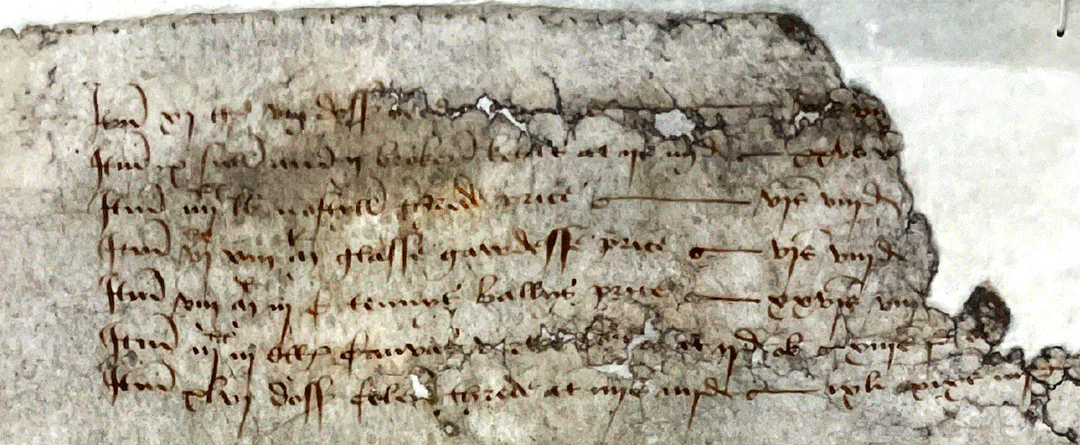
These shipments would have gone on become the shop stock of London’s general retailers. The probate inventory of London Haberdasher Henry [Harry] Wyngar (d. 1502) recorded 8300 tennis balls as part of his shop stock. These were collectively valued at 26s 8d (or 0.038 pence each). This formed part of haberdashery goods worth £131 – including 128,000 glass gawdess (or large beads used in rosaries). Unfortunately much of the rest of the inventory has not survived.
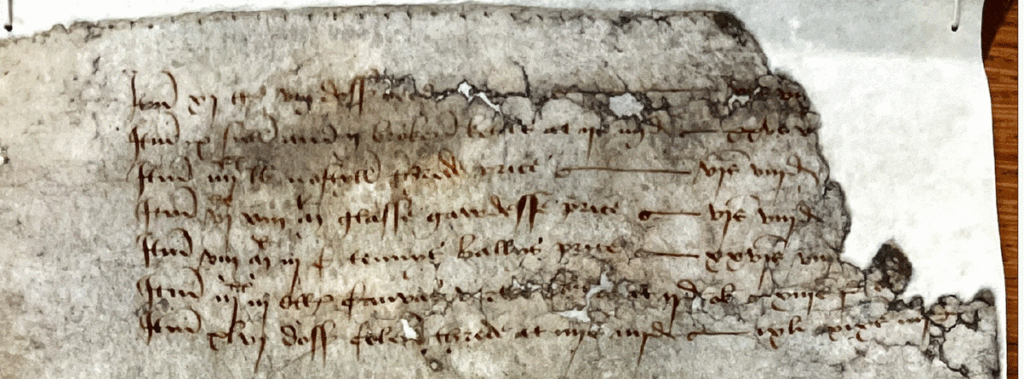
Detail from TNA PROB 2-169 – Probate Inventory of Henry Wyngar, London Haberdasher (d. 1502).
Delightfully, Wyngar can be seen importing 2 “fatts” or vats of “balls” in October 1494:
De Henrico Wyngar, indigena, de navibus Ricardi Harryngton et Simonis Robson, pro una cista et uno fardello continentibus 60 pecias Holande, 12 lb. amber, 4 pecias sayes, 500 ulnas canvas, 4 corf fili Utnard et 2 fattes balles. [Precii] …. £62
[of Henry Wyngar, indigenous merchant, from the ships of Richard Harrington and Simon Robson, for 1 chest and 1 fardel containing 60 pieces of Holland cloth, 12lb amber, 4 pieces of Saye, 500 ells of canvas, 4 corfs of Oudenaarde thread and 2 vats of balls. [Valued]… £62.
The ubiquity of tennis is reflected in the number of fifteenth century urban and guild statutes which insisted that tennis, alongside other games like cards, dice and football be restricted. In 1418 the London Grocers’ company prohibited the playing of tennis in their company hall to anyone other than those who were freemen shopholders [fremen shoppeholderys] suggesting that all ranks of their members, including apprentices, had been playing at the tenyes. The 1460s Ordinances of Worcester also stipulated that “that no man pley at tenys or pame wtyn the yeld halle.” Pame or palm being another word for tennis in this period.
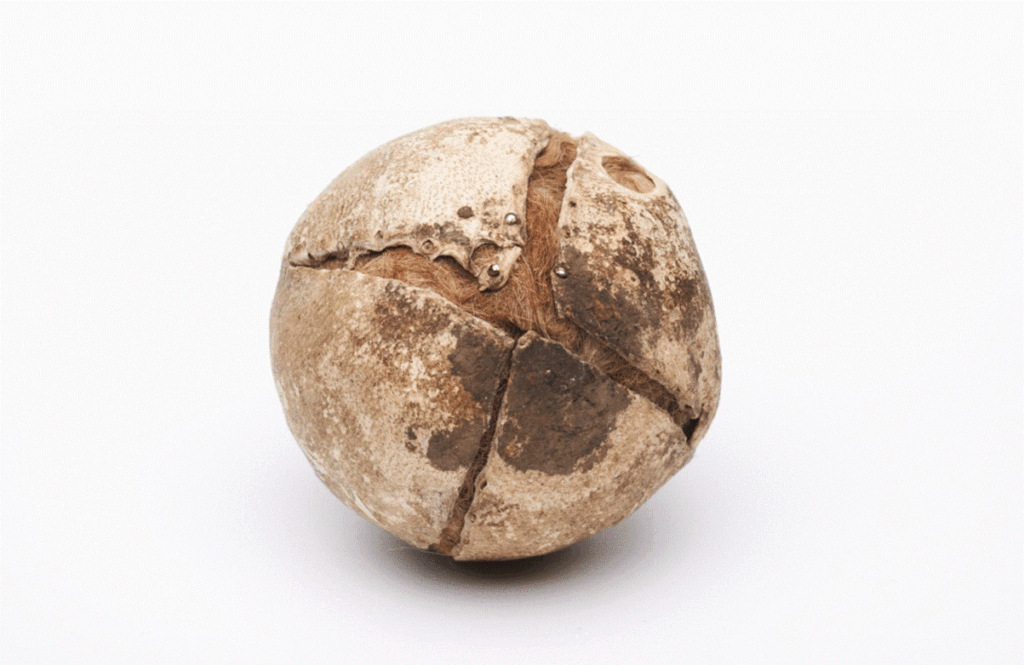
Perhaps most famously a fifteenth or sixteenth century tennis ball was found in the roof rafters of Westminster Hall in the 1920s and can now be found in the collections of the London Museum. This example is made with leather and stuffed with dog hair!
Of course, tennys balls have always been used for a range of play activities rather than just tennis; they may have been given to pets to play with or for other children’s games, just as they are to this day. Tennis rackets were also imported: Edmund Nic[h]olson (also known by the aliases Edmund Clayson and Haymaund Clayson) a merchant of Antwerp, who appears ubiquitously in the LCA between 1505-1520 imported a cargo containing rackets in May 1520. Nicolson is a particularly good example of the wide ranging trading interests of Low Countries and London merchants in this period:
De Edmundo Nicolson, alienigena, de nave Martini Albright, pro 2 maundes et 1 bag cum 400 lb. ynkyll, 7 dossenis rakettes, 10 dossenis parvorum rakettes, 1000 allhaftes, 12 dossenis bages cum lokes, 14 dossenis lokes, 3 tabull depictis, 12 dossenis pannorum depictorum, 6 dossenis horse combz, 24 dossenis dog cheynez, 14 dossenis pannorum depictorum, 4 dossenis panni brushis. Precii £27 13s 4d sub’a 27s 8d
[Of Edmund Nicolson, alien, from the ship of Martin Albright, for 2 maunds and 1 bag with 400 lb. incle, 6 dozen rackets, 10 dozen small rackets, 1000 awl-hafts, 12 dozen bags with locks, 14 dozen locks, 3 painted tables [usually devotional images], 12 dozen painted cloths [tapestry/wall hangings], 6 dozen horse-combs, 24 dozen chains for dogs, 14 dozen painted cloths, 4 dozen cloth brushes. Valued £27 13s 4d Subsidy 27s 8d ]
Tennis balls provide just one example of the incredibly diverse imports of cheap consumable goods arriving in London in the fifteenth and sixteenth centuries. Items described as “pro pueris” or for children can be seen regularly in the accounts and include clothes, bags, toys, writing tablets. Caps and hats seem to have been particularly prominent imported goods for children. Games, toys, musical instruments and other recreational objects are regular features of the London customs accounts and constitute an understudied feature of overseas trade in this period. Together, this shows us that medieval England was a lot more fun that many of us might imagine!
Dr Eliot Benbow is a Research Associate at the IHR working on the AHRC-DFG funded project “Unlocking Upcycled Medieval Data: North Sea Networks, People, and Commodities in the London Customs Accounts 1380-1560”. Previously he undertook a PhD at Queen Mary, University of London and the London Museum on the material culture of devotion in later medieval London between 2019 and 2024. His wider research interests include the study of medieval and Early Modern London, devotional culture, trade, and migration with a focus on material culture and connections between England and the Low Countries.