

In this blog post, Dr Louise Ryland-Epton describes the gestation of the latest Victoria County History (VCH), publications for Wiltshire, which focus on Chippenham and its neighbourhood. In looking at how this work was informed by earlier scholarship—notably that of John Aubrey (1626–97)—Louise places the modern work of the VCH in the long tradition of place-based scholarship which will, in turn, be celebrated in a series of events and publications in 2026 under the banner of Chippenham – Our History.
.jpg)
This March is the 400th anniversary of the birth of the polymath John Aubrey at Kington St Michael, near Chippenham. Aubrey is celebrated for his pioneering work on prehistoric monuments, particularly his recognition of the significance of Avebury, which he brought to wider attention and compared systematically with other stone circles. However, he is best known today for his ‘brief lives’, vivid, gossipy biographical sketches of his contemporaries that captured their essence through anecdote and detail rather than formal narrative. Yet, in biographical notes about Aubrey written by others, he is invariably described as an antiquarian, someone focused on objects of antiquity. The term implies to me someone who catalogues and describes ancient and unusual things. There is undoubtedly this aspect to his work, witness his output on Avebury and Stonehenge, but his work on Wiltshire also reveals him to be something closer to what we would now recognise to be a local historian. And there is great synergy between Aubrey’s labours and methodology and that of the Victoria County History today. The aim of the Victoria County History project or VCH (as we generally refer to it), is to produce histories of every place in England from the earliest time to the present.
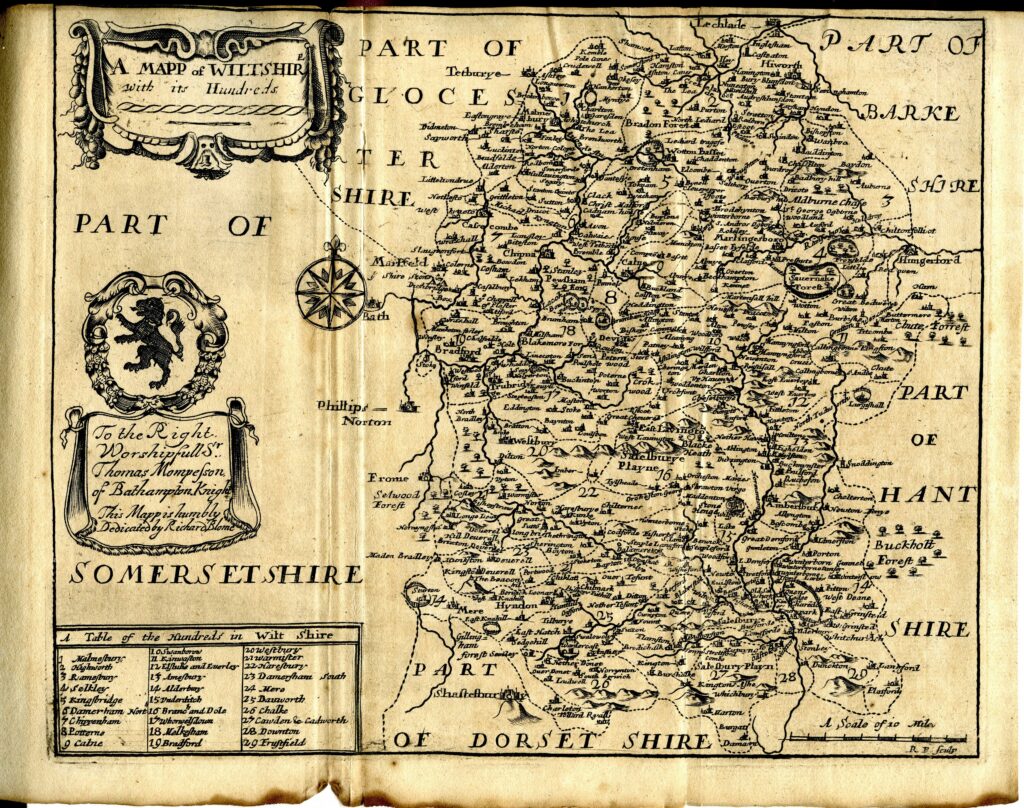
Aubrey recognised that the local, the parish level, was valuable and worth recording. Consider his observations on individual parishes in his topographical notes on north Wiltshire, MS Aubrey 3 at the Bodleian Library, Oxford. It has a bounded geographical focus, and after an introduction which gives a history of the county from earliest times, it is organised by parish and hundred (an ancient county subdivision), so clearly reflected by the work of VCH Wiltshire today. Though the depth of his descriptions of these parishes may vary, it is clear that Aubrey did not seek to cherry-pick the most interesting places. This systematic, parish-by-parish approach had its origins in a collective endeavour remarkably similar to the founding of VCH Wiltshire itself. In 1659, a group of Wiltshire ‘gentlemen’ met and decided to produce a county history influenced by William Dugdale’s Antiquities of Warwickshire. Though the other participants eventually fell away, Aubrey persevered, becoming in effect the sole ‘county editor’ working methodically through north Wiltshire. This parallels the establishment of VCH Wiltshire in the 1940s, when another group of committed individuals came together to create a systematic county history—though in that instance, with the support of the then County Council. We continue to this day, though, mercifully, we are a team.


In his natural history of Wiltshire (MS Aubrey 1 and 2 at the Bodleian Library and MS 92 at the Royal Society)—the first systematic county survey of natural history attempted—Aubrey used an expansive 17th-century definition of natural history unfettered by modern preoccupation with biological science. Instead, he recorded Wiltshire’s physical and human landscape: soil, plants, agriculture, weather patterns, cheese-making, building materials, local superstitions, etc. These observations, while thematically arranged, are rooted in place, and seek to understand why Wiltshire and the places within it were as they were. The work is analytical, not just descriptive. The evidence Aubrey draws on in both works included landscape, objects, and memory, not just what was to be found in documents. Aubrey spoke to ordinary people, not just the elites. In these manuscripts there are stories and biographical vignettes, which makes the place-based content meaningful, interesting, and accessible. This is something I mirror in my VCH partnership publications, which present VCH research in an accessible and popular format.
Aubrey’s topographical notes were ‘corrected and enlarged’ in Wiltshire. The Topographical Collections of John Aubrey, 1659-70, produced by J.E. Jackson in 1862. Because they remain so useful, these were important to our creation of Wiltshire VCH XX, Chippenham and Environs, which addresses an area that includes Aubrey’s birthplace. The Topographical Collections provided my first introduction to Aubrey’s work. Moving from the printed edition to the manuscript, the minutiae of Aubrey’s notes and illustrations provided me with a unique insight into these places in the 17th century, and into their previous history. For my work on Kington St Michael, Aubrey’s notes included sketches of early glass in the parish church which did not survive subsequent renovations and the cracked church tower which fell in subsequent decades. A Victorian, John Britton, published Aubrey’s Natural History of Wiltshire in 1847, but edited it, selecting what he deemed most interesting and omitting much that seemed mundane, wrong or salacious. Ironically, this editing undermined the systematic nature of the work and removed some glorious parish-level detail. In June this year I will be publishing the full text of Aubrey’s natural history for the first time, through Hobnob Press.

The VCH itself compiled county natural histories in its early volumes and, as these are digitised, the synergies between Aubrey’s pioneering work and the VCH’s approach become even clearer. It is serendipitous that 2026 also sees the publication of Wiltshire VCH XX, Chippenham and Environs. As part of that Chippenham is preparing for a celebration of its rich and diverse past. Chippenham – Our History brings together Chippenham Museum, Wiltshire VCH Trust, Wiltshire and Swindon History Centre, Chippenham Library, and the wider community in a year-long festival of events, exhibitions, and creative projects that explore the history of Chippenham and its surrounding villages. The centrepiece of the programme will be an exhibition—Wiltshire & the World: John Aubrey and the Quest for Knowledge, which will run at Chippenham Museum from 12 June to 19 September 2026, and will showcase all aspects of Aubrey’s scholarship, including local history.
Aubrey’s work remains relevant to the efforts of the VCH. It is systematic, place-based, and, delightfully, socially inclusive historical research. Looking forward, I find Aubrey so pertinent. Inherent in his topographical and natural history manuscripts is anxiety. Places had changed and were changing. Landscapes had become deforested, grasslands enclosed, marshland drained; species had become scarce; ancient monuments and buildings had been damaged or destroyed; local practices were dying. Although hopeful for the future and encouraging of innovation and improvement, change was not necessarily for the good. Just one more thing on which we agree.
Louise Ryland-Epton is a freelance historian and editor. A contributing editor to VCH Wiltshire and Herefordshire, she is a Research Associate of the IHR and visiting fellow of the Open University.
Website: https://www.louiserylandepton.co.uk/
Bluesky: @lrylandepton.bsky.social