

In this blog post, Gaverne Bennett (PhD student at the University of Leicester) and Jenny Lelkes-Rarugal (BBIH editor) discuss how the Bibliography of British and Irish History (BBIH) can be used to research and teach the histories of race and ethnicity.
What is BBIH?
BBIH is one of the most accurate and comprehensive resources available for studying, teaching and researching the domestic and global histories of Britain and Ireland, from 55 BCE to the present day.
An academic partnership between the Institute of Historical Research (IHR) and Brepols, it provides up-to-date information on over 670,000 history books, articles, chapters, edited collections (mainly published from the early 20th century to present), and history theses (submitted since the late 1990s). BBIH is updated 3 times a year, with c.10,000 new records annually.
BBIH and the histories of race and ethnicity
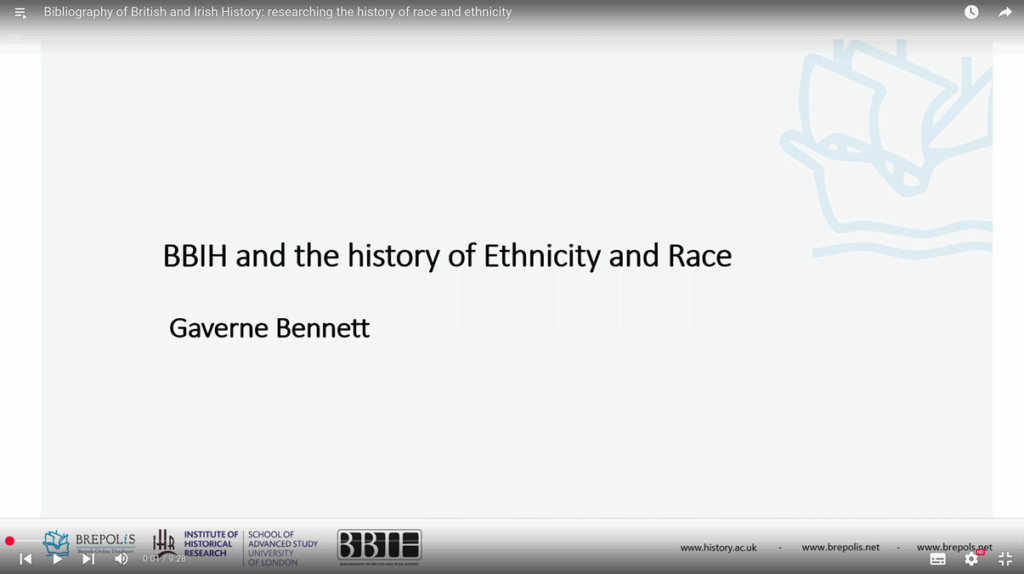
Due to its name and geographical focus, BBIH’s potential for studying, teaching and researching interdisciplinary and emerging areas within history is not always obvious or intuitive to historians. To address this, Gaverne Bennett has made a tutorial video about how BBIH can be used for studying, teaching and researching the histories of race and ethnicity. Gaverne’s tutorial video can be watched on the IHR’s website and YouTube channel. Later in this blog post, Gaverne will share their experiences of designing and making their video.
As part of their original internships, both Gaverne and Dr Leah Veronese reviewed the keywords in BBIH’s unique subject tree related to race and ethnicity. The purpose of this was twofold:
- To review existing keywords in BBIH’s subject tree, ensuring that the language used continues to be appropriate, inclusive and relevant for historians working in this field.
- To identify new and emerging topics and historical methods imperative for studying, teaching and researching the histories of race and ethnicity that were missing from BBIH’s subject tree.
Many of Gaverne’s and Leah’s suggested changes and new additions were published in the October 2025 update to the Bibliography. Gaverne’s tutorial video and BBIH’s updated subject tree are supported by our free online reading list Researching Black British history (460 items). When used together, historians now have powerful ways of finding reliable, accurate, and trusted resources about race and ethnicity using BBIH.

Gaverne’s experiences of designing and making their video
Making the video on how to explore the BBIH represented a fascinating and fitting end of an internship journey that started in 2023. I had been brought in to look over and ‘refresh’ – through consideration of elements such as language – the sections of the BBIH that related to race and ethnicity.
I came across BBIH when I was researching a timeline I made for The Guardian and The British Library. However, this was the first time that I had really looked at the database in detail and began understanding just how much a powerful resource it was for any historian as it had unique ways of guiding and simplifying investigation no matter how complex.
After a brilliant introduction to how the BBIH actually works by Jenny Lelkes-Rarugal, I got to understand the full range, breadth, and knowledge BBIH offers. At first, it was deeply daunting trying to work out how to explain what was available without scaring away prospective historians or being so overladen with information it would be unintelligible.
With clear, concise and patient guidance from Jenny, I was able to work out ways navigating my way around key elements of the BBIH – its subject tree and new interface features, for example – and consider how new developments in the area of race and ethnicity could be brought to bear on certain aspects of BBIH to make it even more user friendly for academics and students.
By the end of my internship, I felt entirely confident to explain how one might navigate BBIH. The video then was not only a joy to do but an engaging challenge because here I had to try to give any given time starved historian months and months of information I had learnt about the BBIH in under 10 minutes.
This required that I use my imagination to remember what it felt like the first time I looked at BBIH. I must say this, I found this leap of imagination most interesting because I had to communicate first and foremost the sheer utility of BBIH in aiding an academic journey in the area of race and ethnicity but also give historians the confidence to feel that they could make BBIH their own, bend it to the needs of their research or teaching.
I also had to figure out how to narrate the script without sounding wooden or hollow. I achieved this by memorising the script then, being sure of its accuracy, considering what emotion and thoughts I wanted each slide to elicit from each historians watching. I wanted viewers to feel that they were following a journey; one that they would feel they would want to continue in their own way afterwards.
In that sense, making the video was the perfect end to my internship because it was a real test: it evidenced whether I had understood all I had learnt about BBIH and being able to communicate succinctly it’s benefits for researching race and ethnicity. If you listen carefully to the video, there is an unmistakable hint of enthusiasm for the ways in which BBIH can aid your research. My reasoning was that a genuine, demonstratable enthusiasm would excite the curiosity of historians.
You can judge for yourself whether this was achieved by watching the video for yourself. I feel it has been a real privilege to be able to not only understand BBIH’s inner workings but be able to communicate this to others who I am certain will benefit from it as much as I have.
Featured image: Image of Black History Mural, Reading, by Andrew Smith, CC BY-SA 2.0, https://commons.wikimedia.org/w/index.php?curid=13140949
Gaverne Bennett is a PhD history student at Leicester university. He has taught at various levels including secondary and FE levels. He is the creator of the Guardian newspapers bestselling timeline wallchart series and a literature timeline for The British Library.
Jenny Lelks-Rarugal Jenny joined the IHR in 2021 and is responsible for the BBIH.