
In celebration of Hallowe’en, we are highlighting four titles in the IHR Library covering ghosts, the devil, and witchcraft. These range from a collection of 17th century broadside ballads about spectral phenomenon to a book on historical interpretation, placemaking, and ghosts at Colonial Williamsburg. Drop by the library to browse these titles and more!
As Hallowe’en rolls around, we thought we’d showcase some of the spookier and scarier books in the IHR Library’s collections. Although the supernatural is not a specialist subject of the IHR, there is still plenty witchy and ghoulish to be found on our shelves. We have highlighted four texts that fit this bill.
The Spirit of Colonial Williamsburg: Ghosts and Interpreting the Recreated Past (Alena Pirok)
This book’s account of Colonial Williamsburg’s attitude towards ghosts provides an examination of the museum’s approach to historical interpretation, and the subsequent impact on its visitors. Ghost stories and tours have been an intermittent feature of historical interpretation at Colonial Williamsburg throughout its history. These were initially used in fundraising efforts during the founding of the museum before falling out of favour for much of the 20th century, replaced by a more academic approach. They are, however, once again, a prominent feature of the museum and its visitor engagement. Pirok’s central argument is that the placemaking and subsequent emotion and connection experienced by the visitor through the mechanisms of ghost stories and tours have been vital to Colonial Williamsburg’s success in engaging its visitors. This book is a unique take on the ‘world’s largest American history museum’ that grapples with questions of public history, memory, and place by examining Williamsburg’s relationship with ghosts.
UF.0975/Vir/Wil/Pir – IHR Onsite Store
On Witchcraft (Cotton Mather)
Originally published as The Wonders of the Invisible World in 1692 by Cotton Mather, a prominent Boston clergyman, this is an essential text for anyone studying the persecution of so-called witches in the colonial United States. Although Mather played no legal role in the Salem Witch Trials he is associated with the events in large part because of this book. On Witchcraft was written following his involvement and he justifies his avid support of the events through the recounting of several trials (as a supposedly objective narrator). In his bid to defend his involvement, Mather enlightens his reader as to the signs and mechanisms of witches and the devil using a heated and urgent tone. He explains how otherwise upstanding Christians may be tempted by the devil to become witches, and how to avoid this fate. This text’s writings provide fascinating and crucial insight into the social and cultural environment of 17th century New England.
ER.858/Mat – IHR Floor 1 Foyle
Women, Witchcraft, and The Inquisition in Spain and the New World (edited by María Jesús Zamora Calvo)
This collection of ten essays presents portraits of women who, under accusations as diverse as witchcraft, bigamy, false beatitude, and heresy, faced the Inquisition in Spain and its colonial territories in the Americas, including Mexico and Cartagena de Indias, to account for their lives. Drawing on the documentary record of trials, confessions, letters, diaries, and other primary materials, each essay focuses on individual cases of women subject to imprisonment, interrogation, and judgment by the Inquisition—and humiliation and contempt by wider society. By placing the collection within a larger framework of women’s history, editor María Jesús Zamora Calvo recovers the silenced voices of persecuted women and exposes how the Holy Office of the Inquisition functioned not only as a mechanism of faith enforcement but as a misogynistic institution grounded in patriarchal hierarchy and gendered oppression.
LA.1614/Zam – IHR Floor 2 Americas
The Pack of Autolycus: or, Strange and Terrible News of Ghosts, Apparitions, Monstrous Births, Showers of Wheat, Judgments of God, and Other Prodigious and Fearful Happenings As Told in Broadside Ballads of the years 1624-1693 (edited by Edward Hyder Rollins)
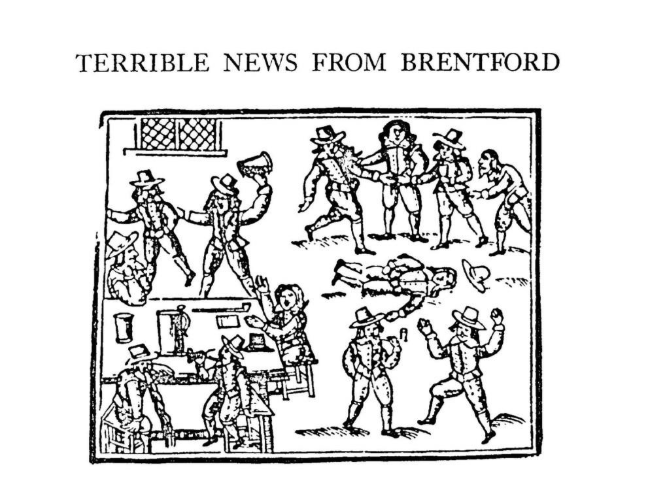
The Pack of Autolycus is an anthology of 17th century English broadside ballads chronicling ‘Strange and Terrible News of Ghosts, Apparitions, Monstrous Births, Showers of Wheat, Judgments of God, and Other Prodigious and Fearful Happenings’. These ballads, often sensationalised but presented as true accounts, reveal popular beliefs, fears, and interpretations of extraordinary phenomena in early modern England. Some of the titles include ‘A Marvelous Murther committed upon George Drawnefield of Brampton in Derbyshire’ (p. 15), ‘The Devil’s Conquest, or A Wish Obtained’ (p.146), and ‘The Disturbed Ghost, or ‘The Wonderful Appearance of the Ghost or Spirit of Edward Avon’ (p.172). These ballads reflect how print culture broadcast sensational tales for popular consumption, presenting the extraordinary as signs of divine wrath or fate. Rollins’ edition preserves the original language and woodcut illustrations, providing valuable insight into the social imagination, religious sensibilities, and folklore of early modern society.
This blog post was written by Sasha Pond and Sarah Snelling, the 2025-2026 Graduate Trainee Library Assistants at the IHR Wohl Library.