
In this blog, IHR Fellow Chris Lewis writes about a new publication
Domesday Book is justly famous as England’s oldest public record, the source of a teeming mass of information about every aspect of English government and society around the time of the Norman Conquest. The recent publication of a hefty co-written monograph, ten years in the making, offers the opportunity to reflect on the making of Domesday Book, the making of Making Domesday, and Domesday scholarship at the IHR.
The new book
Stephen Baxter, Julia Crick, and C. P. Lewis, Making Domesday: Intelligent Power in Conquered England (Oxford: Oxford University Press, 2025)
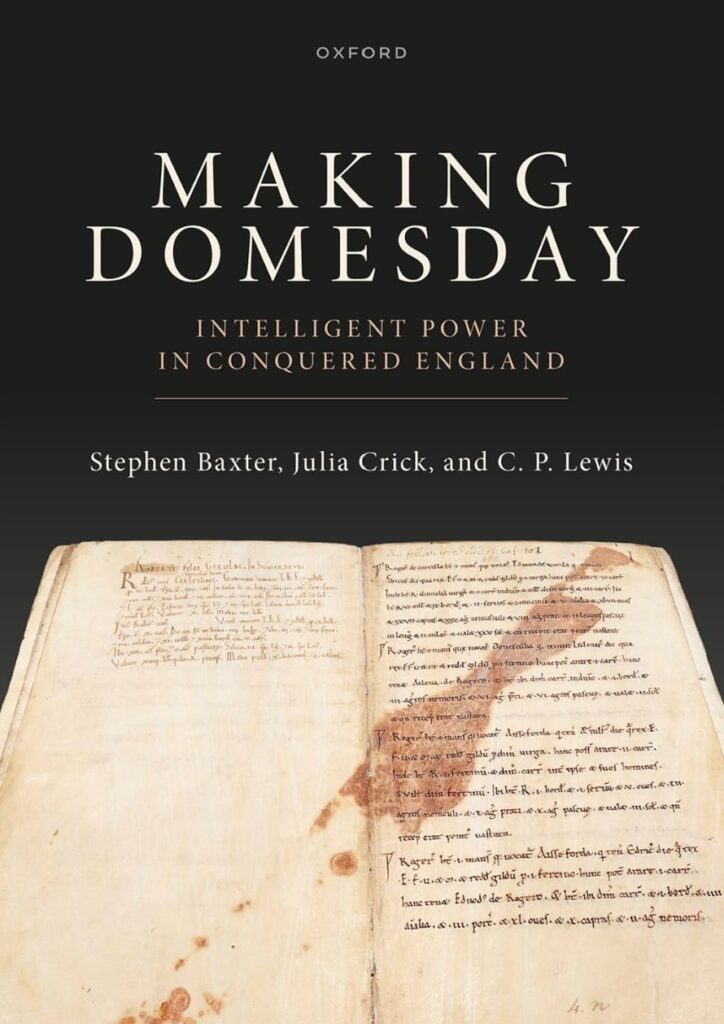
Manuscript image © Dean and Chapter Exeter Cathedral
Making Domesday presents a fresh interpretation of William the Conqueror’s survey of England. It was made possible by a major collaborative study and a new online edition of Exon Domesday, the earliest of the three original manuscripts to survive from the Domesday survey of 1086. The book addresses big questions about premodern government, written records, and the use of intelligence in both senses: the minds behind the planning and execution of Domesday, and the information about England that Domesday gathered. It characterizes Exon as the surviving part of the ‘working papers’ of one of the writing offices that over a period of ten weeks in summer 1086 dealt with all seven ‘circuits’ (regional groupings of shires) of the Domesday survey. The circuit offices had the task of recasting the manorial descriptions assembled in an earlier stage of the survey into an interim form intended for further redaction as Great Domesday Book by rearrangement, rewording, and abbreviation. A new deep understanding of the codicology and palaeography of Exon underpins every part of the analysis, and offers a model of documentary production for royal government at an exceptionally early period in western Europe. Making Domesday makes the case that the Domesday survey was planned and implemented by the king’s clerical and episcopal advisers as a group, rather than by a single mastermind, but also that the scribe of Great Domesday can be identified as the bishop of Winchester’s nephew Gerard, sometime royal chancellor and eventually archbishop of York.
Part I of Making Domesday describes and analyses each Exon text in unprecedented detail; Part II places Domesday in context and in broad comparative perspective, ranging across and beyond the Latin West. The dual approach provides a new interpretation of Domesday and a deeper understanding of both the Domesday survey and Domesday Book. It emerges that the survey was even more complex than we had dared to imagine, involving the production of different kinds of text intended to meet a range of revenue-raising and political needs. It is also clear that the survey was immediately effective, transforming the politics of land in a newly conquered society. Domesday has always been thought awesome, as its very name suggests in referring to the Day of Judgement from which there was no appeal. Making Domesday contends that it was also a feat of intelligent government deployed by an aggressive and ambitious regime. As such it speaks to broader concerns with the colonial domination of conquered societies through the purposeful collection of systematic statistical information.

Image © Dean and Chapter Exeter Cathedral
Exon Domesday
Exon Domesday (Exeter, Dean and Chapter Library and Archives, MS 3500) is a collection of documents generated by the Domesday survey which has been known to scholars since the mid-eighteenth century and in print since 1816. The collection relates to only one part of the kingdom—the five south-western shires of Wiltshire, Dorset, Somerset, Devon, and Cornwall—and is missing about a third of its original content. Even in its incomplete state it is priceless for understanding Domesday, because it is the earliest of the three surviving original manuscripts of the survey, compiled by a large group of scribes working under intense pressure in the summer of 1086. Once Domesday Book itself was written, Exon served no further purpose and was intended for disposal. Its accidental survival, having travelled first to Wells in Somerset before reaching Exeter probably in the earlier thirteenth century, is little short of miraculous.
In 2011 the manuscript’s 1816 binding was removed, making it possible to study Exon using modern forensic methods. Exon Domesday was the focus of a large-scale collaborative research project funded by the Arts and Humanities Research Council (AHRC grant AH/L013975/1, October 2014–December 2017). The project was led by Professors Julia Crick (KCL, Principal Investigator), Stephen Baxter (Oxford), and Peter Stokes (now Sorbonne, Paris) (Co-Investigators), and drew on a team of specialists with expertise in Domesday studies, palaeography, and digital humanities. The project’s website (www.exondomesday.ac.uk) gives free access to a facsimile of the manuscript, a complete edition and translation of the text, a comprehensive page-by-page description of the manuscript, and other tools and resources.
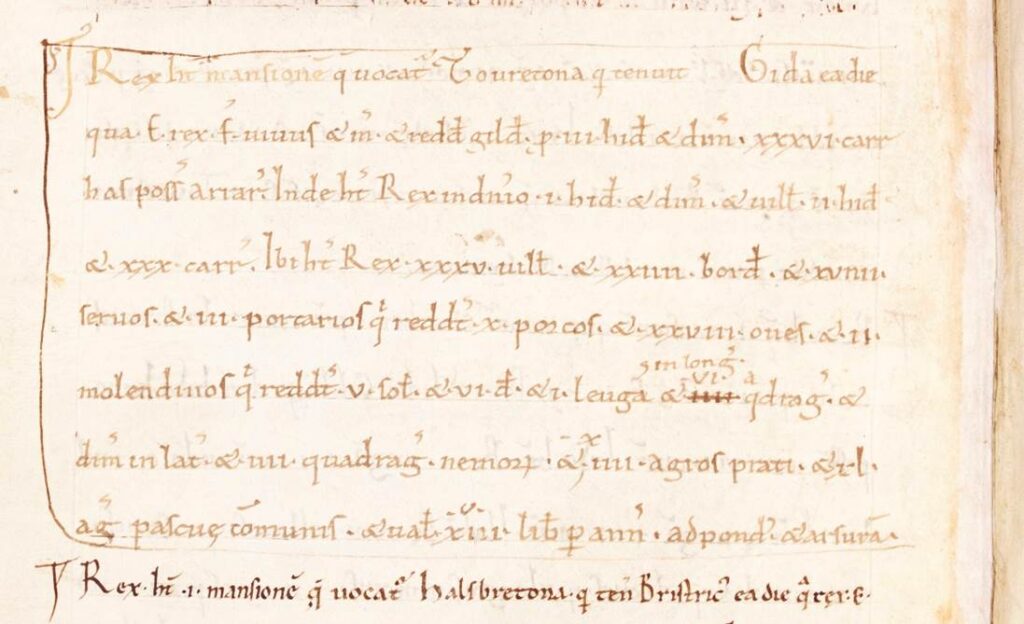
Image © Dean and Chapter Exeter Cathedral
Making Making Domesday
The co-written monograph that has emerged from the collaborative research project of 2014–17 was originally intended to be an extended commentary on Exon Domesday, worth doing for its own sake but relatively limited in ambition. As we began to think about the implications of what the team had discovered, however, it became clear that we had a springboard for something much more significant. At the conclusion of funded research, the three authors dispersed to pursue three different but overlapping lines of enquiry.
Stephen Baxter read through the whole of the existing scholarship on Domesday Book from the 1750s onwards to expose its weaknesses and identify how our new understanding of Exon changed the picture. He also situated the routine activities of Norman government (especially in the areas of land taxation and land tenure) and the extraordinary effort of the Domesday survey into the widest possible contexts. That took him backwards and forwards in English history, and outwards from England to the Carolingian and post-Carolingian West, Byzantium, Egypt, and even Song China in search of comparisons for understanding the capabilities of premodern government.
Julia Crick surveyed the enormous number of contemporary manuscripts from north-western Europe for which images are now available on the Web. She was looking for the hands of the two dozen scribes who together wrote Exon Domesday, identifying where they might have been trained, and thinking about how a precious survival of precisely dated, ephemeral, bureaucratic writing destabilizes current views about scribes in the later eleventh century.
Chris Lewis burrowed deep into the different sorts of record preserved in Exon Domesday. They are chiefly manorial descriptions, lists of contested tenures, accounts of the land-tax (geld) of 1085–6, and ‘executive summaries’ of the key statistics for baronial estates. He also paid close attention to Exon’s many and sometimes puzzling contemporary and later annotations. In the end it was possible to build a picture of how the Exon writing-office was organized as a team of scribes. Anonymous medieval scribes are usually assigned sigla sometimes using the letters of the Greek alphabet. Capitalizing as Alpha, Beta, and so on had the effect of assigning them ‘names’, helpful in thinking about them as real individuals who were engaged in a momentous task of writing.
Our own labours were prolonged by the Covid lockdowns, the number of chapters grew to twenty, and the word count approached half a million, but that gave us time to discuss each other’s contributions even more thoroughly and stitch our arguments together even more tightly.
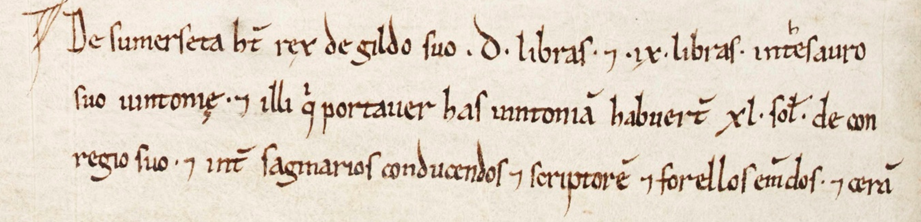
Image © Dean and Chapter Exeter Cathedral
Domesday at the IHR
The Domesday survey and Domesday Book have been the subjects of an ever-deepening pool of scholarly investigation since the 1750s. The IHR has long been a focus for research on Domesday Book, not least because two of the directors have been involved in Domesday studies. V. H. Galbraith (director 1944–8) was appointed shortly after his ground-breaking article on ‘The making of Domesday Book’ in the English Historical Review for 1942. That article and the monograph of the same title which followed in 1961 provided a revolutionary account of how Domesday Book was compiled which held the stage for a generation. David Bates (director 2003–8) published a comprehensive annotated bibliography of Domesday in the octocentenary year of 1986 and has made many contributions to Domesday studies through his extensive work on William the Conqueror.
My own contribution to Making Domesday has deep roots in the IHR library and the collegiality of the Earlier Middle Ages seminar. The library has nearly everything needed by students of Domesday Book, and is probably better stocked than anywhere outside the copyright libraries, as a subject search for Domesday Book reveals.
- the primary edition of Domesday Book of 1783 in two large folios, with the additional volumes of 1816 which include the primary edition of Exon Domesday
- the Alecto edition of 1986, which provides facsimiles of Domesday Book and county-by-county translations and introductions
- editions of related texts like Domesday Monachorum and Inquisitio Comitatus Cantabrigiensis
- much of the extensive secondary literature on Domesday, widely spread in monographs, essay collections, articles in national and local journals, and other local publications dating from the later nineteenth century onwards
- masses of supporting material, especially in the British local collections (not least the Victoria County Histories) and in the outstanding collection of editions of Norman cartularies from the library of David Douglas
Even a dedicated scribe can get distracted …

Image © Dean and Chapter Exeter Cathedral
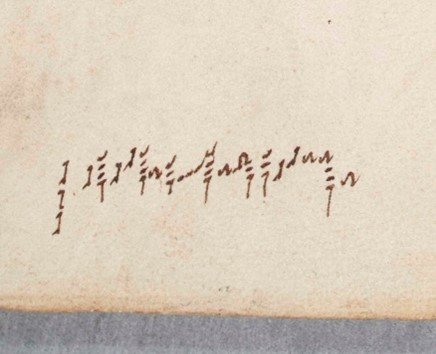


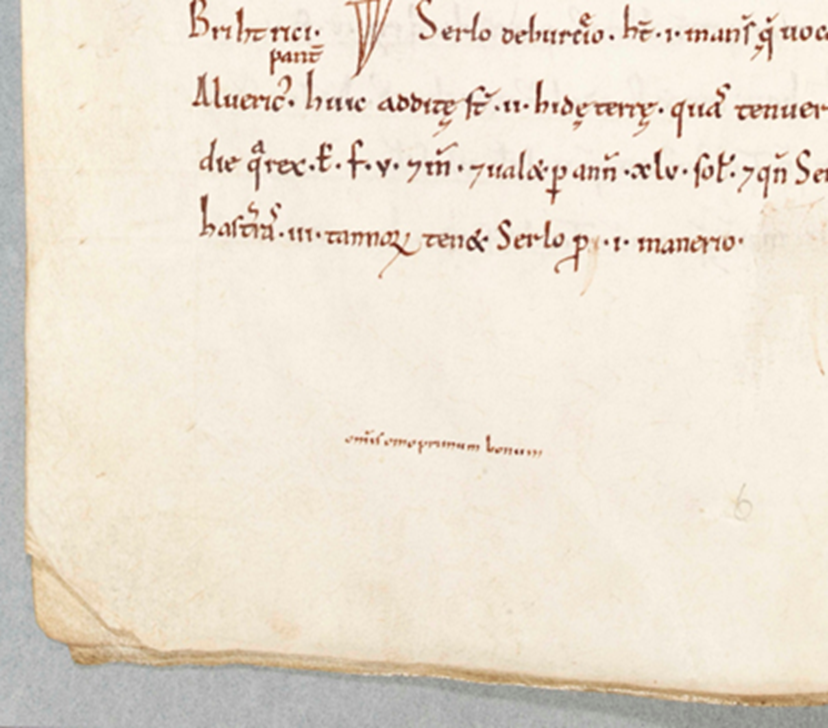
Image © Dean and Chapter Exeter Cathedral
Chris Lewis took early retirement from the Victoria County History at the IHR in 2009, having worked on Cambridgeshire, Cheshire, and Sussex. Since then he has been an IHR Fellow, researching and publishing mainly on English history in the central Middle Ages.